
If you are searching for easy space facts for kids, fun space facts for children, or simple astronomy facts explained for beginners, this guide is perfect for you.
Space may seem complex, but many basic ideas can be explained in a simple and fun way.
In this article, you’ll discover 10 easy and educational space facts that are perfect for kids, beginners, and anyone who wants to understand the universe without confusion.
1. The Sun Is a Star
The Sun may look very different from the stars you see at night, but it is actually the same type of object—a star.
The reason it looks so big and bright is because it is much closer to Earth than other stars. Other stars are very far away, which is why they appear small and faint.
The Sun gives us light and heat, making life on Earth possible. Without it, our planet would be cold and dark.
2. Earth Spins to Create Day and Night
Earth is always spinning, even though we don’t feel it.
It takes about 24 hours for Earth to complete one full rotation. This movement causes day and night.
- When your part of Earth faces the Sun → it is daytime
- When it turns away from the Sun → it becomes night
This simple movement is something we experience every day without thinking about it.
3. The Moon Reflects Light from the Sun
The Moon does not produce its own light.
Instead, it reflects sunlight, just like a mirror reflects light.
That’s why the Moon looks bright in the night sky. Depending on its position, we see different shapes of the Moon, called phases (like full Moon, half Moon, etc.).
4. There Is No Air in Space
Space is a vacuum, which means there is no air.
Because of this:
- Humans cannot breathe in space
- Sound cannot travel
This is why space is completely silent. Even if something explodes, there would be no sound like we hear on Earth.
5. Gravity Keeps Everything in Place
Gravity is an invisible force that pulls objects toward each other.
On Earth, gravity keeps us on the ground. In space, gravity keeps planets moving around the Sun and moons orbiting planets.
Without gravity, everything would drift away into space, and the solar system would not stay organized.
6. Jupiter Is the Biggest Planet
Jupiter is the largest planet in our solar system.
It is so big that more than 1,300 Earths could fit inside it.
Jupiter is a gas giant, which means it is made mostly of gas rather than solid ground. It also has a giant storm called the Great Red Spot, which has been active for hundreds of years.
7. Space Is Extremely Cold
Space does not have an atmosphere to trap heat.
As a result, temperatures can drop to around -270°C (-454°F).
This makes space one of the coldest places imaginable. However, objects close to the Sun can become extremely hot at the same time.
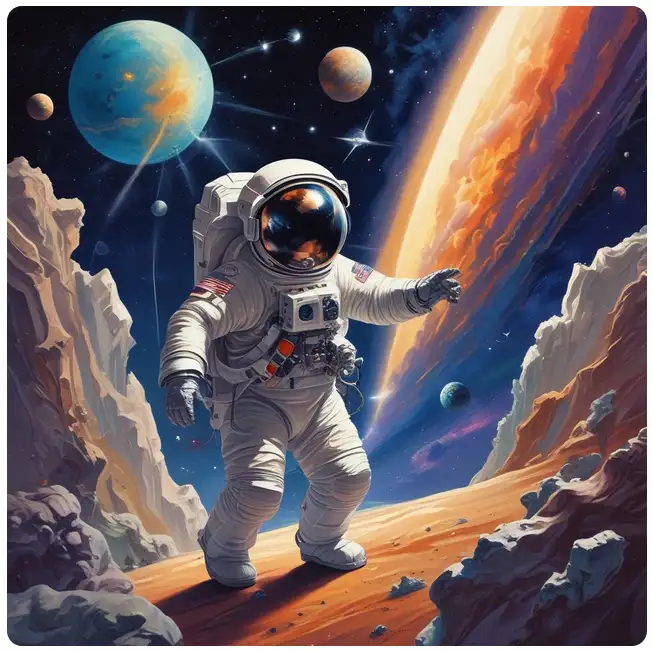
8. Astronauts Float in Space
Astronauts seem to float in space, but this is not because there is no gravity.
Instead, they are in a state called microgravity.
They are constantly falling toward Earth, but because they are also moving forward very fast, they stay in orbit. This creates the feeling of floating.
9. The Earth Is Part of a Galaxy
Earth is not alone in space.
It is part of a large system called the Milky Way galaxy.
This galaxy contains billions of stars, along with planets, dust, and gas. The Sun is just one of those stars.
Understanding this helps us see how small our planet is compared to the universe.
10. There Are Many More Planets Beyond Our Solar System
Scientists have discovered thousands of planets outside our solar system.
These are called exoplanets.
Some of them are very different from Earth, with extreme temperatures or unusual environments.
Scientists continue to study these planets to learn more about the universe and to see if life might exist elsewhere.
These easy space facts for kids help explain some of the most important ideas about space in a simple and clear way.
They are useful for:
- Learning basic science
- School assignments
- Building curiosity about the universe
👉 Which fact did you find the most interesting?
If you want to explore more fun space facts for children and simple astronomy topics, you can continue learning step by step with similar content.