
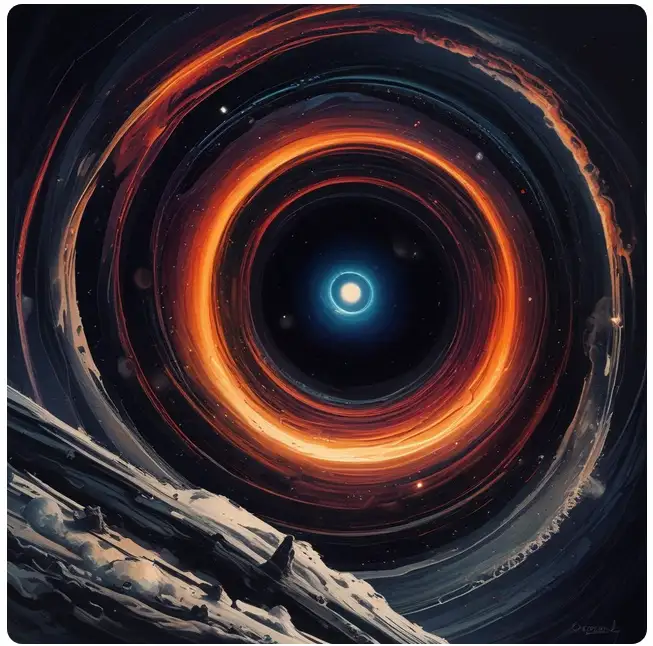

Black holes are some of the most mysterious objects in the universe. If you’re looking for mind-blowing facts about black holes, educational science facts, or amazing space discoveries, this article is for you.
These cosmic phenomena are strange, extreme, and sometimes almost impossible to imagine—but they are very real.
Here are 10 mind-blowing facts about black holes that will expand your understanding of space.
1. Black Holes Can Bend Light
The gravity of a black hole is so strong that it bends light around it, a phenomenon called gravitational lensing.
This means that objects behind a black hole can appear distorted or magnified.
Scientists use this effect to study distant galaxies and mysterious parts of the universe.
2. There Are Different Types of Black Holes
Black holes are not all the same.
- Stellar-mass black holes: Formed when massive stars collapse
- Supermassive black holes: Found at the centers of galaxies, millions to billions of times the Sun’s mass
- Intermediate black holes: Sizes in between
- Primordial black holes: Hypothetical small black holes from the early universe
3. Nothing Can Escape a Black Hole
Not even light can escape the event horizon, the boundary around a black hole.
This is why black holes appear black—they emit no light.
Everything that passes the event horizon is pulled in irreversibly.
4. Black Holes Can Spin
Black holes can rotate at incredible speeds, sometimes close to the speed of light.
This rotation drags space and time around it, creating extreme effects like frame-dragging, where spacetime itself twists.
5. Hawking Radiation Allows Black Holes to Evaporate
Stephen Hawking predicted that black holes are not completely black.
- They emit a small amount of radiation
- Over billions of years, they can slowly lose mass and evaporate
This was a groundbreaking discovery connecting quantum mechanics and gravity.
6. Supermassive Black Holes Are Enormous
The largest known black holes can be billions of times heavier than the Sun.
For example, TON 618, a supermassive black hole, has an estimated mass of 66 billion Suns.
These massive objects dominate the centers of galaxies, including our Milky Way.
7. Black Holes Can Merge
When two black holes collide, they merge into a larger black hole.
This process releases gravitational waves, ripples in spacetime, which have been detected by observatories like LIGO.
This discovery confirmed a major prediction of Einstein’s theory of general relativity.
8. Black Holes Can Affect Time
Near a black hole, time moves slower compared to areas farther away.
This time dilation effect is a real prediction of Einstein’s relativity and has been measured indirectly.
A trip near a black hole would make you age much slower than people far away.
9. Some Black Holes “Feed” on Matter
Black holes can pull in gas, dust, and even stars from nearby objects.
This material forms an accretion disk around the black hole, heating up and emitting X-rays before disappearing beyond the event horizon.
10. Black Holes Are Invisible but Detectable
We cannot see black holes directly because no light escapes them.
However, astronomers detect them by observing:
- The movement of nearby stars
- X-rays from accretion disks
- Gravitational waves from collisions
These indirect methods reveal the hidden presence of black holes throughout the universe.
Black holes are extreme, mysterious, and fascinating.
These mind-blowing facts about black holes show how strange and amazing the universe can be.
💬 Which fact surprised you the most?
📲 Share this with someone curious about space and science!